
Watch now (here is a direct link)
Listen now



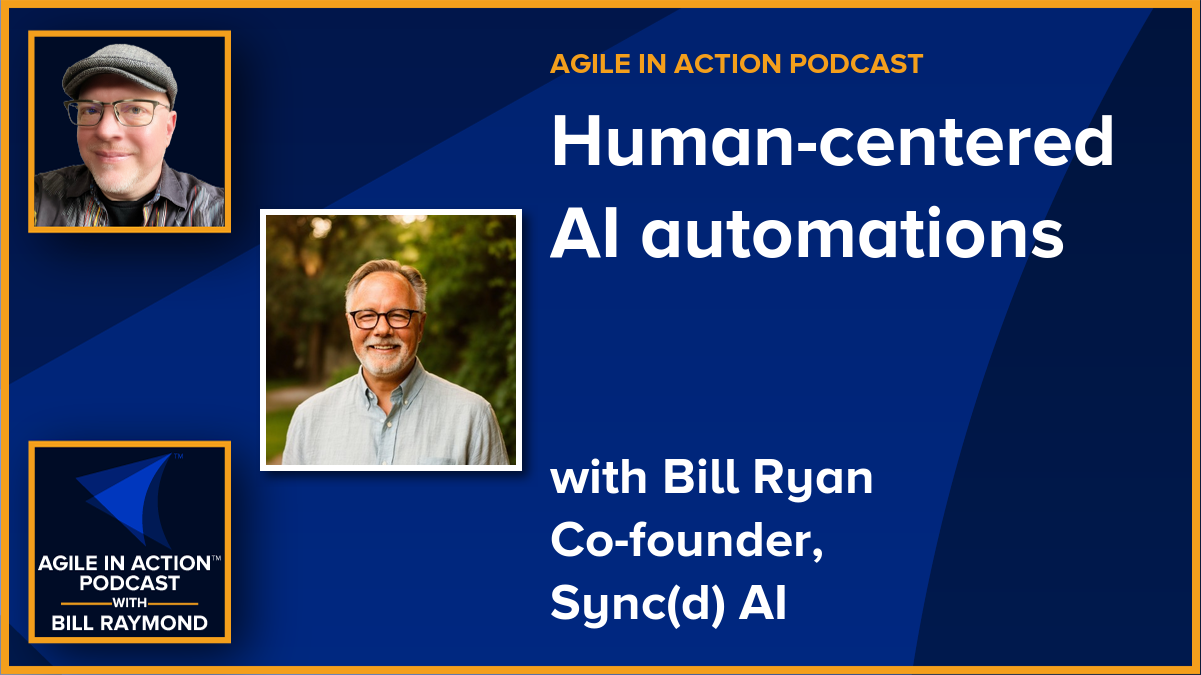
Human-centered AI automations
Bill Ryan, Co-founder, Sync(d) AI
About this podcast episode
Human-centered AI automations
[00:00:00] Introduction
Bill Raymond: Hi, and welcome to the Agile in Action Podcast. I’m Bill Raymond, and today I am joined by Bill Ryan. Hi Bill, how are you today?
Bill Ryan: I’m great, thank you. How are you, Bill?
Bill Raymond: I’m doing wonderful. Thank you. You are the founder and partner at Sync(d) AI, and you and I had a few conversations about how companies are speeding up their processes, reducing work that needs to be done over and over again, and you talk a lot about human-centric AI. You’ve also talked about. How you might implement AI projects, and I loved your ideas, so I thought it would be wonderful to have you on the podcast.
Bill Raymond: Before we get started, can you share a little bit about what got you on this AI journey?
Bill Ryan: Oh wow. Thank you for having me today. What got me on this journey?
[00:00:49] Bill Ryan’s AI Journey at Microsoft
Bill Ryan: I started working with AI when I was employed at Microsoft. I was with Microsoft for five years. I was at the beginning of the whole Microsoft AI age.
Bill Ryan: With Copilot and Copilot Studio and the growth of Copilot and AI embedded into application platforms and the Office platform, but then also moving into the agentic world and the whole concepts around using agents to do work that, that people would manually do previously. And it is an absolutely fascinating and groundbreaking technology. I think we are on the verge of something really transformational. This is like the birth of the internet and it is a monumental shift in terms of how people work and what people do. And so I’m absolutely fascinated with the whole concept of human-centric AI, which is a focus around
[00:01:39] Human-Centric AI Philosophy
Bill Ryan: building AI solutions that include humans rather than replace them. And the idea is that you should design AI systems and implement AI systems with people in mind. If you don’t have adoption and people don’t buy into using the technology.
Bill Ryan: They’re not going to use it. And so when you take a human-centric approach to implementing AI, you are circumventing the fear and the and the distrust that people inherently have in something that is gonna take their jobs away. So our whole mission is to educate companies on how they can implement AI in a responsible, human-centric way that doesn’t get rid of their people, but enhances their ability to do more where a company of 10 can punch way above their weight and act as a company of a hundred or a company of a hundred can act like a company of a thousand using AI in the proper way. So that’s really our mission and what we’re focused on and helping companies really understand what that concept is.
Bill Raymond: Yeah, you and I are very much aligned on this. I do think that as small businesses we have to juggle a lot of balls in the air. At the same time, we have lots of tasks that we have to complete. We still have happy customers that we need to keep happy. And sometimes things can get a little overwhelming.
Bill Raymond: And it used to be that we just have to hire and hire in order to solve some of these problems. We still do. And that’s the case, is that there are still jobs that we need, but there’s a lot of things that just are repetitive, difficult tasks to get done that we know we can do best ourselves because we know the craft of what we do, but then we have to slog through it all the time.
Bill Raymond: And I’m finding that right now at this point in time, that’s where AI is really useful.
Bill Ryan: Absolutely.
[00:03:31] Practical AI Applications for Small Business
Bill Ryan: I’ve got many examples of using AI to help us start our business. And things like using AI to, to create a marketing plan which, you know, last year or even the year before or two, three years ago, I would’ve had to have hired a marketing consultant to put the plan together.
Bill Ryan: I’d have to have done a lot of research because I didn’t really understand or know what a marketing plan was and what went into it. AI gave me a very quick education and it gave me an expert partner that was right by my side the whole time I was putting that plan together. So I could ask it questions and say what is top of funnel?
Bill Ryan: What is middle funnel? What’s the bottom of the funnel? What does that mean? And all of the things that go into marketing concepts that a marketing expert would know that I didn’t. And I was able to. Glean that information really quickly and put a really comprehensive plan together in a very short period of time.
Bill Ryan: Share that with my partners, iterate on it, go back to AI, iterate on it there, and really work as a team to be able to get something done in a very short period of time. That would’ve, taken us an enormous amount of time to do, and enormous number of people to be able to make that happen.
Bill Ryan: So I think that’s a really good example of where AI can really streamline and improve and speed up your ability to get things done. Which is an absolutely fascinating concept. When you apply that to business and you apply that to companies that are working today in mapping out use cases for where they can apply AI and what they can do with AI.
Bill Ryan: It’s really important to understand what those use cases are, what happens, and then be thoughtful about where you’re going to use AI and where it’s going to be injected into the process. Who’s gonna manage it, and who’s going to be the AI partner, if you will, the one that is asking AI the questions and then getting that information back and doing something with it and sharing it with the teams.
Bill Raymond: Yeah, I love that example. And of course I think, when we think about AI, very often we think about this little prompt box where we type something and we either get what we want or we don’t, and we chat through it until we finally get to the result we’re looking for.
Bill Raymond: And I love the, that kind of an approach and it’s really useful. Like you said, it’s almost like this collaborative business partner that’s sitting right there next to you. But then there’s another thing that we’re starting to see in business as well.
[00:05:52] Understanding Agentic AI and Workflows
Bill Raymond: And this is that term Agentic AI and Agentic workflows.
Bill Raymond: And this is where maybe the AI starts to do things on your behalf. And I would love for you to lay out what might your typical workflow process look like at a business that you might then AI-iffi add that AI agentic element to it.
Bill Ryan: We’ve been working with Workflow for many years.
Bill Ryan: I think Power Automate from Microsoft has been around for 10 years. Prior to that it was SharePoint workflow and it was part of the SharePoint server platform. And they moved that out when they went to the cloud. And then it became its own workflow engine. So there’s a lot of companies that have built a large number of business workflows that do things like, for instance, when an email comes into an inbox it reads the email and then does something, or it notifies somebody of something that happens.
Bill Ryan: You can have conditional workflows that if this then else then do this. And you can even have workflows that wait for something. So they will wait for input from someone and then go and do something else. Those are not necessarily what you’d call smart workflows. They’re basically instructional workflows.
Bill Ryan: Agentic is like adding a very large brain to a workflow. So you could take that workflow that you created and add that to an agent that basically with the agent, you set the parameters of what the scope of the agent does. So what do you want this agent to do?
Bill Ryan: What memory or what intelligence are you giving it? For instance, you can give an agent access to a set of documents or documentation. Like for instance you could have an agent that reads through all of your training material that you have on your website and provides insight for people that are asking questions about it.
Bill Ryan: But an agent basically is a very smart workflow. Workflow is still a part of it. But you’re defining the scope of what the agent’s gonna do. You give it the guardrails in terms of where it can go and where it can’t go and who it’s going to interact with. And then you give it agency, you give it the ability to actually run.
Bill Ryan: So what you’re doing is you’re taking all of those manual processes that you had and that complex workflow that you created, and you’re giving it super intelligence. Where you’re plugging in AI and you’re actually attaching it to, whether it’s Microsoft and Copilot or you can create an agent with ChatGPT. You can do that with Anthropic. All of the AI engines now give you the ability to create an agent. Some of them are more complex and more sophisticated than others. But the ability for you to take that workflow that you created, reuse it and add AI to it, is absolutely amazing. When you think about the power of the new AI capabilities around agentic.
Bill Ryan: There’s another concept to agentic, and that is autonomous agents. Let’s say it’s an invoicing agent, that there’s an invoice that comes into an email box. It looks at the invoice, it processes the invoice, and then it tells another agent that the invoice is there and it needs to do something else, or maybe it’s an order and then it needs to fulfill the order so we can pass that off to another agent.
Bill Ryan: That agent can then fulfill the order, and then it can go on and on until your process is complete. That can run by itself. That’s called autonomous agent or an autonomous, agentic process.
Bill Raymond: One of the interesting things about agentic AI and all these capabilities that these products offer is that it helps you solve very specific problems, and you can start doing that right away for yourself.
Bill Raymond: I just worked with a salesperson that wanted to enrich their leads from a website where someone would just enter their name and their email address. Press a send button and off it goes. And now that’s all he has. AI agents can go and head to LinkedIn, Instagram, social media, all these different places, pull information about what that person is, their profile, and even suggest lines to start the conversation with them and even go into the sales and marketing material that they have and recommend some of that. These are all amazing AI workflows, but they’re personalized and there might be something that works for me, but not for you.
Bill Raymond: So you want to tweak it a little bit. But I think the bigger play here at the end of the day is where AI is going to provide some real significant outcomes. Now, when you and I talked before, we were chatting about all these different ways that we were seeing our clients use AI. But you had shared a really interesting one about a bottling company, and I know we can’t mention the name of them, but it would be great if you can share just how far you can take this technology.
[00:10:47] Real-World Example: Smart Bottling Equipment
Bill Ryan: The example I’m gonna talk about is a a global bottling company. And when you go to the store and you go to a any big box store or any grocery store, and you see that little refrigerator with the soda pop and the water and all of the beverages that are at the end of the aisle.
Bill Ryan: Those used to be basically dumb machines. They were basically just refrigerators that were plugged in. And now what companies are doing is they’re using AI to be able to identify when they need to send somebody out to refill the bottles because there’s a little camera in it.
Bill Ryan: If the the device is showing that something’s wrong, they can ship out somebody to repair it before it turns itself off or it spoils product. When you think about. The inventory. Traditionally what happens is there would be a person who worked for the company that would basically go from store to store, and that person would have a route and they would have a truck and they would take beverage and they would go in and they would assess what they need, go back out to their truck, get what they need, fill it out, and fill it up, and then fill all of the devices, they’re called cold drink devices or cold drink equipment, CDE. And they were just basically refilling, off they’d go with the use of AI. Now they can automate and streamline that, where the agent basically says, this machine needs these many bottles of this product.
Bill Ryan: And the person that goes and delivers knows exactly what they need to do. They know if they need to go to that store or they don’t need to go to that store. So it streamlined their route. It streamlined the way that they work, and it saved them enormous amount of time. And now what they’re doing is.
Bill Ryan: They’re starting to do things like save power where when the store closes, they’ll raise the temperature of the of the cold drink equipment device and save power and save a refrigerant and all the things it takes to cool. And then just before the store opens, they’ll bring the temperature back down again.
Bill Ryan: So it’s the optimal temperature when you open the door and you grab the drink, it’s cold in your hand. And so there’s things that are not only impacting sustainability and having an impact on the environment because they’re driving less they’re being more efficient in terms of getting in the right product at the right time.
Bill Ryan: But the machines are smart enough to be able to do things like save power and let them know when something’s wrong that they can get something fixed before it becomes a significant problem. These are huge when you think about the scale of how many of those cold drink equipment, devices are at the end of each aisle of every store that you can think of globally, it’s massive.
Bill Ryan: I think there’s something like 11 million of these cold drink equipment devices out there, and they’re getting smarter and smarter all the time. And it’s agents that are basically monitoring and running the process of maintaining those end devices that you see when you go to the store.
Bill Ryan: It’s absolutely fascinating.
Bill Raymond: What does it look like if maybe there’s a team getting together and they’re trying to say, where might we use automation and how might we implement it?
Bill Raymond: Is there any kind of an approach that you might use that you’d recommend?
Bill Ryan: Yeah, so we have
[00:13:58] Implementation Approach: Agentic Workshops
Bill Ryan: we have what we call our agentic workshops and typically what we do when we work with organizations is we sit down and we set up a set of workshops. These are really designed for us to be able to listen to what the company is doing.
Bill Ryan: Let’s choose one that looks like a good candidate for what we call an MVP or a proof of concept. And then we actually work with them to implement that and get that into dev. We don’t, typically, when we work with customers, take an MVP and put that into production. That’s another process that we have, that we work with.
Bill Ryan: So it’s a step-by-step process. One where it’s really important to sit down and think about what it is you want to use AI for and what business processes it’s going to implement. Once you’ve identified that and the how and the what and where the AI components are. Are we gonna use an agent?
Bill Ryan: Are we gonna use multiple agents? Is this gonna be a human in the loop process? Or is this gonna be an autonomous process, one that’s gonna run on its own? Or is it gonna be a combination thereof that you’re bringing together? And then what does that process look like? Mapping that out, building a project plan that allows you to implement it, and then moving forward with that project to get it implemented and done.
Bill Ryan: It’s a traditional sort of project implementation process, but it’s a little bit different in the sense that you’re not implementing software that, that somebody is going to utilize and maintain. You’re implementing a process that could potentially. Just run on its own and do its own thing.
Bill Ryan: So you have to be very careful about responsible use, making sure that you’re connecting and you’re not sharing data. You shouldn’t be sharing. You wanna look at things like the human-centric side of things and make sure that you’re taking care of the people who were doing that work before.
Bill Ryan: As we get to the end of this podcast, I’d like to ask you, you’ve gone through this before.
Bill Raymond: We’ve seen lots of amazing things that AI can do. We’ve talked about some pretty incredible stuff here on this podcast that is actually saving people money and time, and that’s really the outcome that we’re looking for and maybe even increasing revenue. So these are really good capabilities that we’re talking about, but someone might be listening to this going, okay, I love this idea of agentic workflows, and I love this idea of making sure that there’s a human in the middle, and I certainly am going to think about policy.
Bill Raymond: But now what do I do? What’s the next step?
[00:16:27] Getting Started: Start Small
Bill Ryan: The thing to remember is start small. Don’t try and boil the ocean. Don’t try and bite off more than you can chew. Find that one thing that you think and in your organization that might add some value and might save you some money or might increase your revenue or give you the ability to punch above your weight in your marketplace.
Bill Ryan: Look for those opportunities and then decide how you wanna move forward with it in terms of how you wanna apply AI to that problem. And then from there, learn it and then be able to go from the sense of understanding something and then trying it out, going back, doing it again.
Bill Ryan: Getting a little bit further and going a little bit deeper and a little bit deeper, and I think you’ve probably seen this many times with your customers is once they get an understanding, a base understanding of AI, and they start to move forward, they get really excited about it and they want to do more.
Bill Ryan: It’s a journey that everybody needs to take and the first step in the journey is figuring out what it is you want to do with AI and how far you want to go.
Bill Ryan: And I can’t emphasize enough. Start small. Choose a really easy project, an easy thing that you can use AI for. Get your understanding of that. Get a feel for how it works and then start to learn how all of these processes work that allow you to continually move forward.
Bill Raymond: That’s a really good advice.
Bill Raymond: Thank you, and I appreciate that because that is something that I went through personally. So if you go onto YouTube and you look up AI agents and AI automations, you’re going to see these people that come up and say. You can build a personal agent that does all these things for you. It answers your email,
Bill Raymond: it’ll update your calendar to read your email and respond to your friends, set up meetings and book a calendar for dinner. Yeah, sure, it can do all of those things. But you have to keep in mind too that was that one person’s way of doing things. Yep. And they also spent hundreds of hours working on that very simple looking thing in the background.
Bill Raymond: Yeah. And so when I went and said, oh, I want to create one of those. I learned that just having a little AI agent that I could just press a button on my phone and say, send me a note that, I wanted to follow up on this particular topic. That took me a few days to build. Yeah. That’s actually pretty incredible that you can do that now.
Bill Raymond: Yep, yep. But that few days also took lots and lots of research and it was a lot more difficult than you might think. So I would follow Bill Ryan’s opinion there and definitely start small, start with a small thing. You can always scale it up later.
[00:19:10] Closing and Contact Information
Bill Raymond: Thank you so much for your time. Before we go, though, is there some way that people might be able to reach you if they want to talk further?
Bill Ryan: Yes. Of course you can reach me on LinkedIn. Look for Bill Ryan or William Ryan as my profile. And you can also reach us at https://syncdai.com, SYNCDAI.com.
Bill Ryan: And we’d happy to, to connect and chat more.
Bill Raymond: Thank you so much for your time today, Bill. Once again, this is a great conversation.
Bill Ryan: Let’s do this again.
Bill Raymond: Yeah, totally.
Bill Ryan: All right.